
Outboard vs Sterndrive. Which is Best? and why?
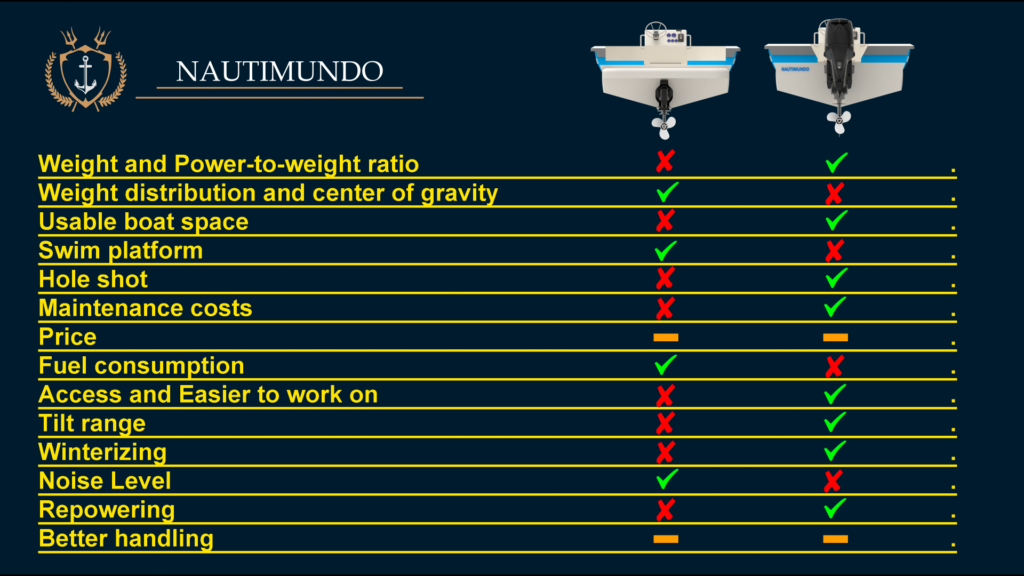
Certain boats are available in two variants, one with outboard and one with sterndrive, or a future boat owner wants to buy a boat and hesitates between two boat models, one with outboard and one with sterndrive.
Each configuration has advantages and disadvantages, and the best option will depend on the future owner's preferences and the boat's intended use.
In this article, we will compare the advantages and disadvantages of each type of propulsion. Analyzing power-to-weight ratio, the center of gravity, fuel consumption, usable boat space, maintainability, cost, noise levels, acceleration, and maneuverability.
So, let's get down to it.
Power-to-weight ratio
Outboard engines generally have a better power-to-weight ratio than sterndrive. Therefore, for the same power, the outboard will be lighter.
Let's take an example. Let's compare two 250 Hp configurations, one with an outboard Mercury Verado 250 and another with a sterndrive Volvo Penta V6-250. We see that the dry weight of the Mercury Verado 250 is 272kg (600 lbs), with a power-to-weight ratio of 0.909 Hp/kg (0.416 Hp/lb), and the weight of the Volvo Penta V6-250 is 410kg (903 lbs), with a power-to-weight ratio of 0.601 Hp/kg (0.277 Hp/lb).
Therefore, the inboard/outboard engine is 304,23 lbs heavier. The outboards' weight savings will allow for better acceleration and a little more speed.
Weight distribution and center of gravity.
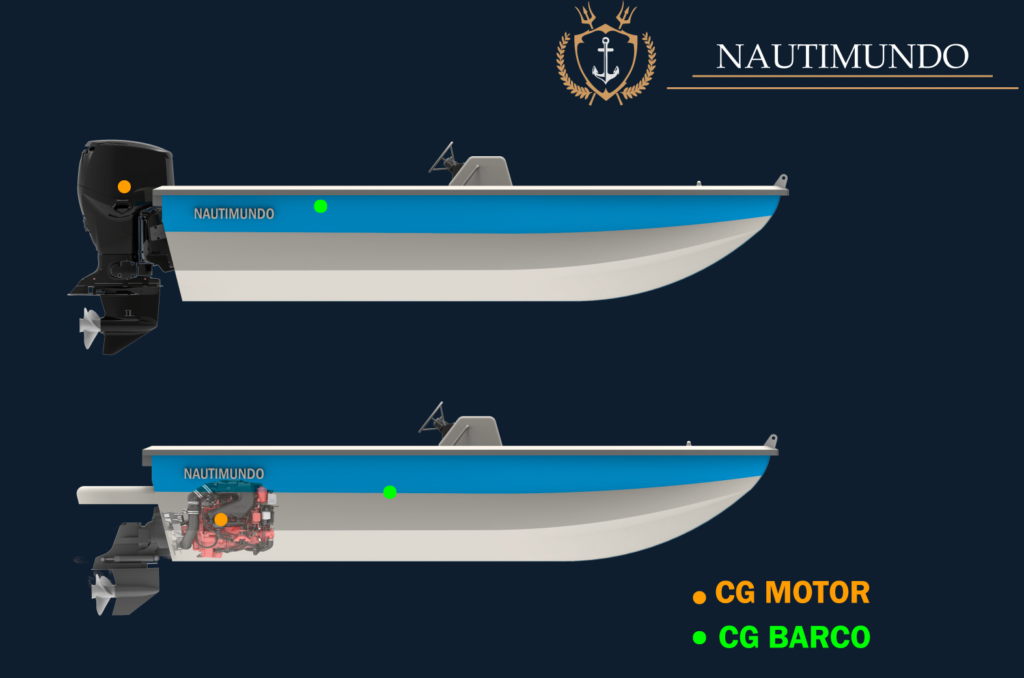
Another factor related to weight is where it is located. With outboards, the entire weight of the engine is behind the transom. Hence, the outboard's center of gravity is further aft and higher than sterndrives engines that have the engine inside the boat, and the center of gravity is forward of the transom and lower, which generally improves stability and handling.
Useful boat space
Outboards hung from the transom do not take up space inside the boat, allowing for a larger cockpit and more storage space. In contrast, this space-saving is impossible with sterndrives, as the engine is installed inside the boat, just forward of the transom.
Swim platform
Boats with sterndrive can have a swim platform that runs the full transom beam. Boats with sterndrive can have a swim platform that occupies the entire transom beam. This is not possible on boats with one or more outboards installed on the transom.
This is something to consider if you plan to use your boat primarily for entertaining family and friends and want easy access to the water.
Fuel consumption and fuel types.
It isn't easy to give a clear verdict as fuel consumption depends on many factors, such as the engine model installed, the boat, the speed, and the engine's rpm.
Theoretically, sterndrives are more efficient, spending less fuel than outboards. But current outboards are very efficient and have achieved low fuel consumption. So if you are hesitating between a boat with outboard and one with a sterndrive, it will be essential to analyze which engine model the boat has.
Anyway, let's take a look at an example.
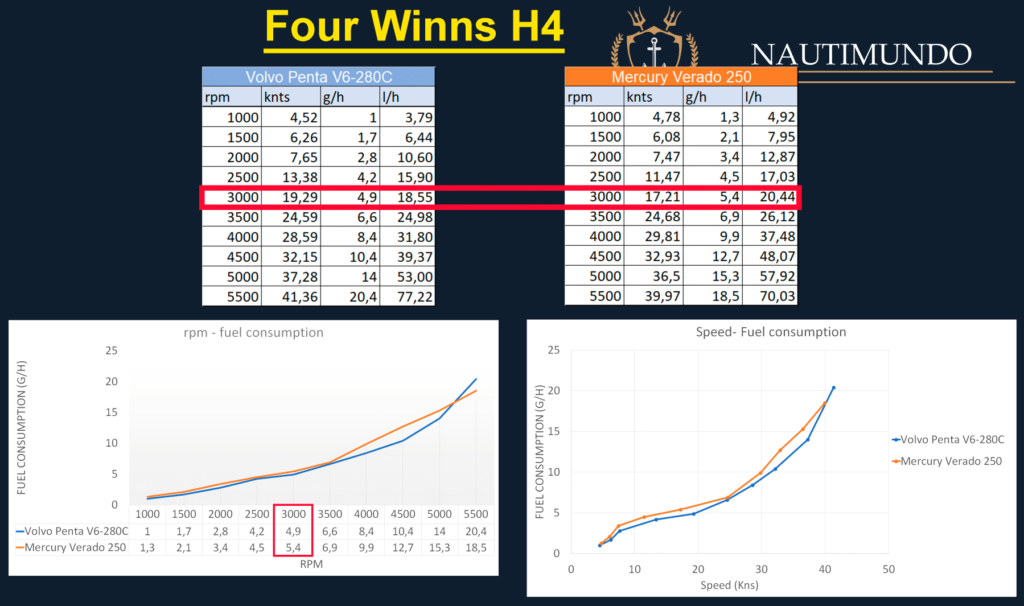
If we compare two Four Winns H4, one with a sterndrive Volvo Penta V6-280C and the other boat with Mercury Verado 250 outboard. We can see in the graph that at 3000rpm, the outboard reached a speed of 17.21 knots with a consumption of 5.4 GPH (gallons per hour). Meanwhile, the sterndrive at 3000 RPM reached a speed of 19.29 knots with a consumption of 4.9 GPH.
We can also observe that at 3500rpm the outboard reached a speed of 24.68 knots with a consumption of 6.9 gph. In comparison, the sterndrive at 3500rpm reached a speed of 24.59 knots with a consumption of 6.6 gph.
Regarding fuel types, in the case of sterndrive, there is a broader range of diesel engines. Diesel inboards tend to have a lower fuel consumption but are more expensive.
If we compare two inboard engines with sterndrive, one gasoline and one diesel. For example, a Volvo Penta V8-300 of 300 hp and Volvo Penta Diesel D4 300 of 300 HP.
The Volvo Penta Diesel D4 300, at the maximum speed of 3500 RPM consumes about 55.00 l/h (14.53 gal/h). In comparison, a Volvo Penta V8-300 at the maximum speed of 5800 RPM consumes about 97.00 l/h (25.62 gal/h).
Maintenance costs
This is one of the sections that generate more uncertainty. Preventive maintenance costs are quite similar, although a little more expensive on the sterndrive. Both require oil changes, filters, spark plugs, water pump impeller, etc. But the sterndrive has more elements to maintain and that increases the cost of preventive maintenance.
When we move from preventive maintenance to corrective maintenance and breakdowns. In general, sterndrives tend to be more expensive to repair. In addition, outdrives are more exposed to corrosion as they are entirely submerged, and the outdrive will need a good antifouling treatment to prevent fouling and barnacles.
Access and Easier to work on
Outboards allow greater overall accessibility because they are mounted on the transom and can be tilted out of the water. While stern drives have good access to the inboard engine, they have poor access to the outdrive submerged in the water. To work on the outdrive, the boat must be lifted out of the water, and to access certain parts, it will also be necessary to remove the outdrive or the engine.
Keep in mind that although outboards are more accessible, this does not mean that it is easier to work on them; working with the engine hanging from the transom with the water around the engine does not make the work easier.
Tilt range
Outboard motors can be tilted out of the water. When the boat is docked, the outboard is out of the water, eliminating the need for antifouling paint and reducing exposure to corrosion. Additionally, tilting the outboard lets all the water drain out of the engine's cooling system, saving it from the risk of unexpected freezing overnight. This allows boat owners in cool climates to extend the boating season, as they do not have to worry about damaging the cooling systems for water freezing.
The outdrive of the sterndrive can be tilted at a certain angle to trim the boat, but it cannot be tilted enough to get it out of the water and is permanently submerged, so it will be exposed to corrosion and require antifouling.
Boat owners with sterndrives need to pay special attention to the sacrificial anodes to protect the outdrives from galvanic corrosion.
Winterization
When winterizing, the average temperature of the area where the boat will spend the winter is very important. If the boat will spend the winter in a warm area where the temperature always stays above 32°F or 0°c, there is not much difference in the preparation of the boat for the winter.
But if the boat is going to spend the winter in an area where the temperature can drop below 32°F, things change. The winterizing process is much simpler for outboards than for sterndrive boats, which means lower costs.
Sterndrives are more sensitive to the freezing risk; winterizing them requires more complex, time-consuming, and costly procedures.
Noise level
A few years ago, sterndrives were much quieter than outboards because the engine was encapsulated inside the boat, while the outboard was on the outside hanging on the boat's transom.
With the advent of the latest four-stroke outboards, this noise difference has been greatly reduced. The outboards have become quiet, improving their sound insulation. This means some outboards can be quieter than sterndrives depending on the engine model and engine speed.
Generally speaking, if you are considering buying a second-hand boat with some years behind it, you can be sure the inboard will be quieter.
However, the sound level of the inboard is greatly influenced by the soundproofing of the inboard engine compartment and the design of the exhaust line, making the difference for the outboard.
Repowering, replacing the boat's engine
In this section, the outboard wins by far.
It is not common to consider replacing the engine when you buy a boat. However, there may come a day when the engine breaks down and needs to be replaced, or you simply want to upgrade to a more modern and fuel-efficient model.
Replacing an outboard is much simpler. On the other hand, replacing an inboard with a more modern engine is a much more tedious and expensive process.
Hole Shot / performance
The better power-to-weight ratio should allow outboard faster acceleration and higher top speed. The higher acceleration causes the boat to get on plane earlier, allowing it to reach cruising speed more quickly.
Better handling
Whether the boat is designed to be powered by outboards or by sterndrive, both will have good handling.
As mentioned in the previous section, sterndrive has a lower center of gravity, allowing for better handling at higher speeds. On the other hand, outboard engines can usually turn more than an outdrive; these additional turning degrees allow the boats to make tighter turns and have better maneuverability, especially at low speeds.
Maneuverability should not be a major factor in choosing one propulsion system over the other.
Stern visibility
This section is related to the previous section. Stern visibility can be hindered by outboard motors, especially if the boat is carrying more than one outboard and the driving position is low.
Good stern visibility can make docking and boat steering easier when practicing towed water sports.
Price
It is very complicated to say which option is more expensive and which is cheaper. There is a great variety of brands and models of outboards and sterndrives, with significant price variations.
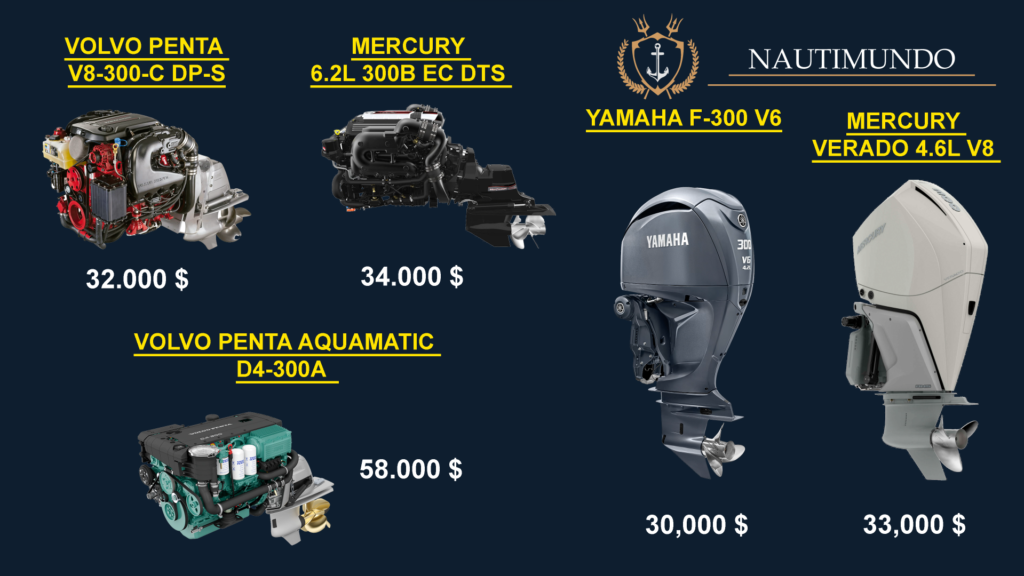
If we compare the prices of different propulsors with a power of 300hp, we can see that a sterndrive VOLVO PENTA V8-300-C DP-S 2.32 will cost around 32000 $, while a Mercury 6.2L 300B EC DTS engine will cost around 34.000 $. On the other hand, a VOLVO PENTA AQUAMATIC D4-300A DP-I diesel inboard outboard will cost around 58.000 $.
An outboard Yamaha f300 300 HP V6 costs around 30.000$, while a Mercury Verado 300hp 4.6L V8 costs around 33.000$.
We can see from these examples that prices are reasonably even except for the diesel engine.
Conclusion
Analyzing the various advantages that each configuration offers, we need to determine which option best aligns with our navigation style and the boat's intended use. If I had to choose between two identical boats, each with a different type of propulsion, I would opt for the one with an outboard engine. My decision would be primarily based on the ability to tilt the outboard motor, lifting the lower unit out of the water when moored at the port. Avoiding having an outdrive permanently submerged and the risks associated with this, such as flooding or sinking if the rubber seals fail. Also, algae and barnacles will grow on the outdrive and propeller over time, decreasing sailing efficiency. However, this is just my perspective.
